Lanes and positions
The safe lane, mid lane and offlane in Dota 2 7.41, what positions 1 to 5 mean, who goes to which lane and why, and how lane matchups are decided.
· Patch 7.41
This page was checked against patch 7.41 and the current patch is 7.41f. The explanation still holds, but any number on it may have moved.
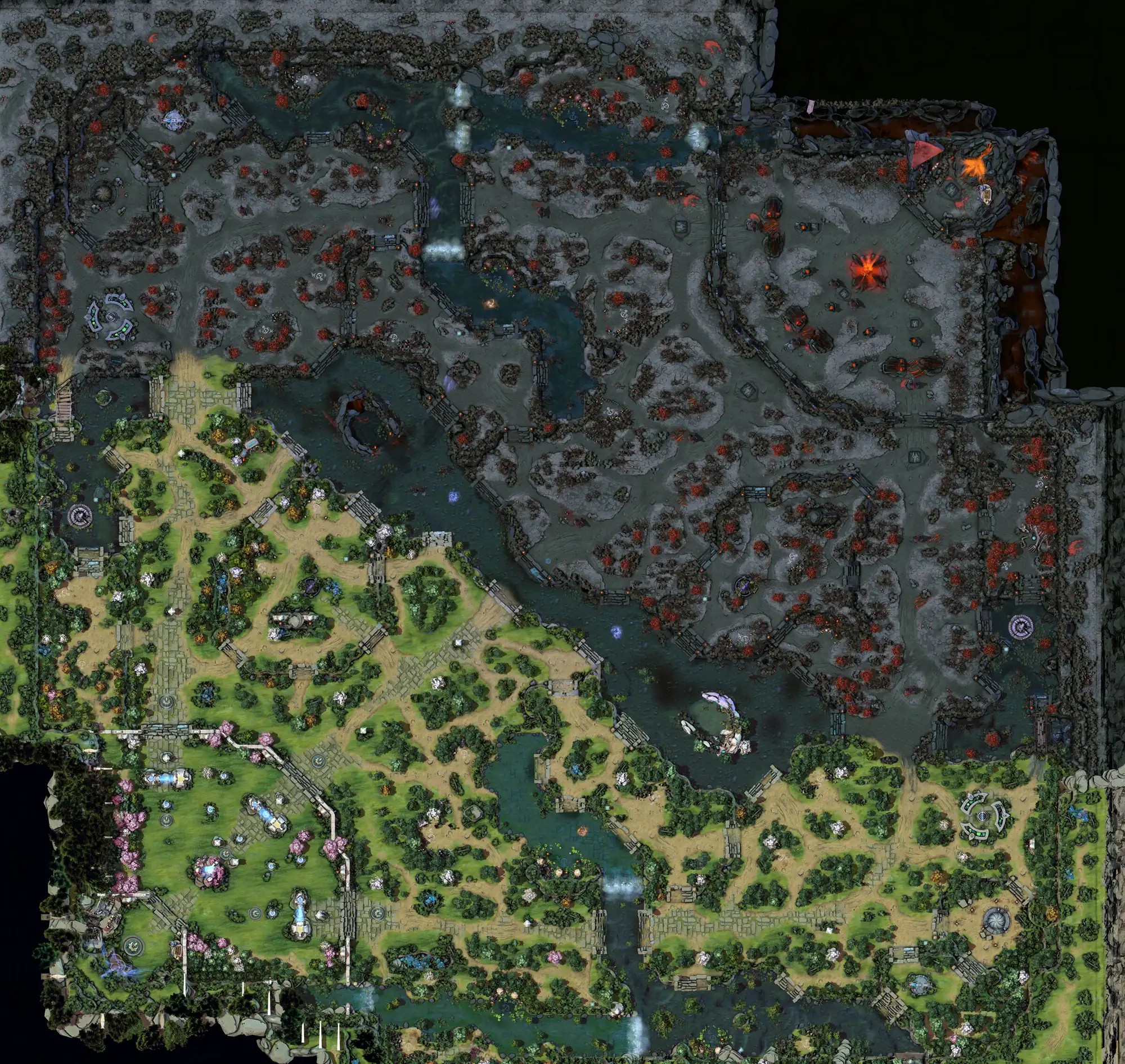

A lane is one of the three paths that creeps walk between the two bases, and a position is a hero's place in the team's farm priority from one to five. Which hero goes to which lane follows from those two ideas: the heroes who need the most gold are sent where farming is safest, and the heroes who need the least are sent to protect them. This page explains the three lanes, the five positions, the standard two-two-one setup and how the matchup in a lane is decided before the first creep arrives.
- Safe lane, mid lane and offlane are the same three paths seen from each side: your safe lane is the enemy's offlane.
- Position 1 to 5 is farm priority, not a lane name; the lane follows from the priority.
- The standard setup is carry plus hard support in the safe lane, one hero mid, and offlaner plus soft support in the offlane.
- A matchup is decided by range, damage, sustain and the pull camps, and the creeps decide the rest.
- Since 7.41 the two side-lane waves meet closer to the offlane tower for the first minutes, which helps the offlane pair.
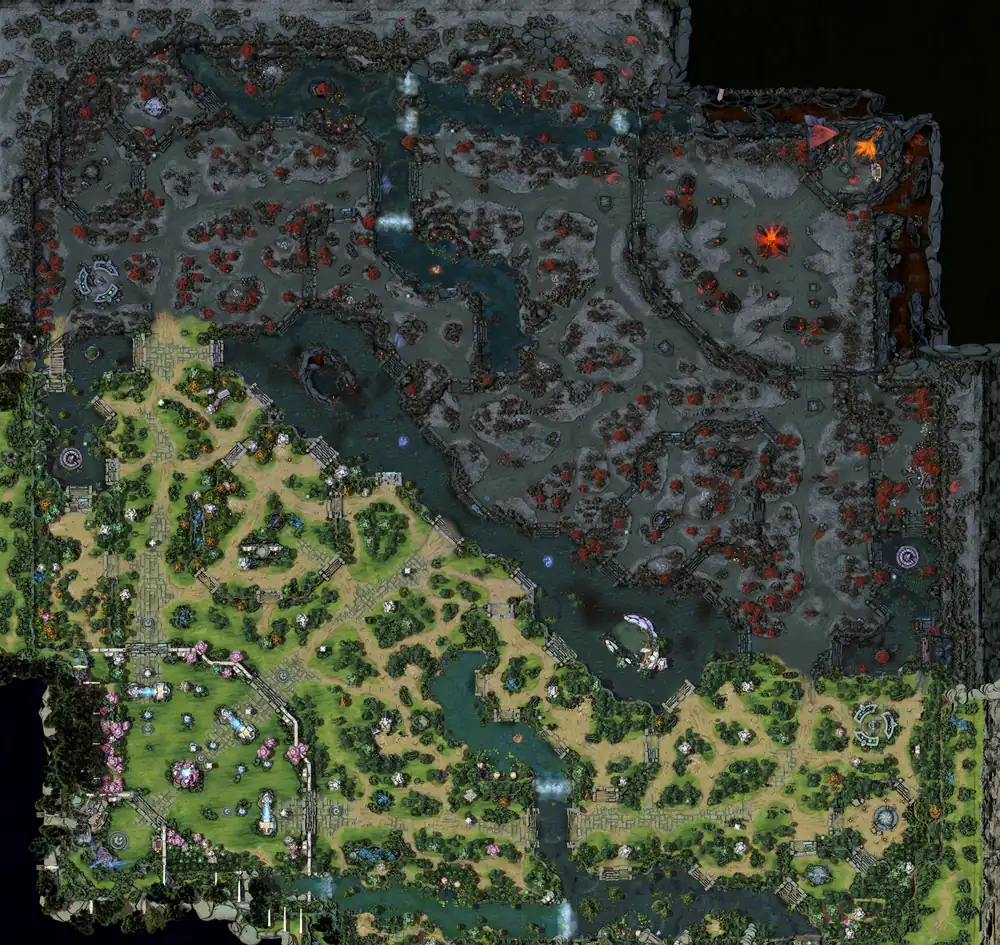
- 1.Top lane
- 2.Mid lane
- 3.Bottom lane
- 4.Radiant base
- 5.Dire base
The three lanes
The The map is a square with the Radiant base in the bottom-left corner and the Dire base in the top-right. Three lanes connect them: the top lane along the left and upper edge, the middle lane straight through the center, and the bottom lane along the lower and right edge. Creeps spawn at each side's barracks and walk their lane until they meet the enemy wave, and the place where they meet is the lane's equilibrium point, explained on Creeps and creep equilibrium.
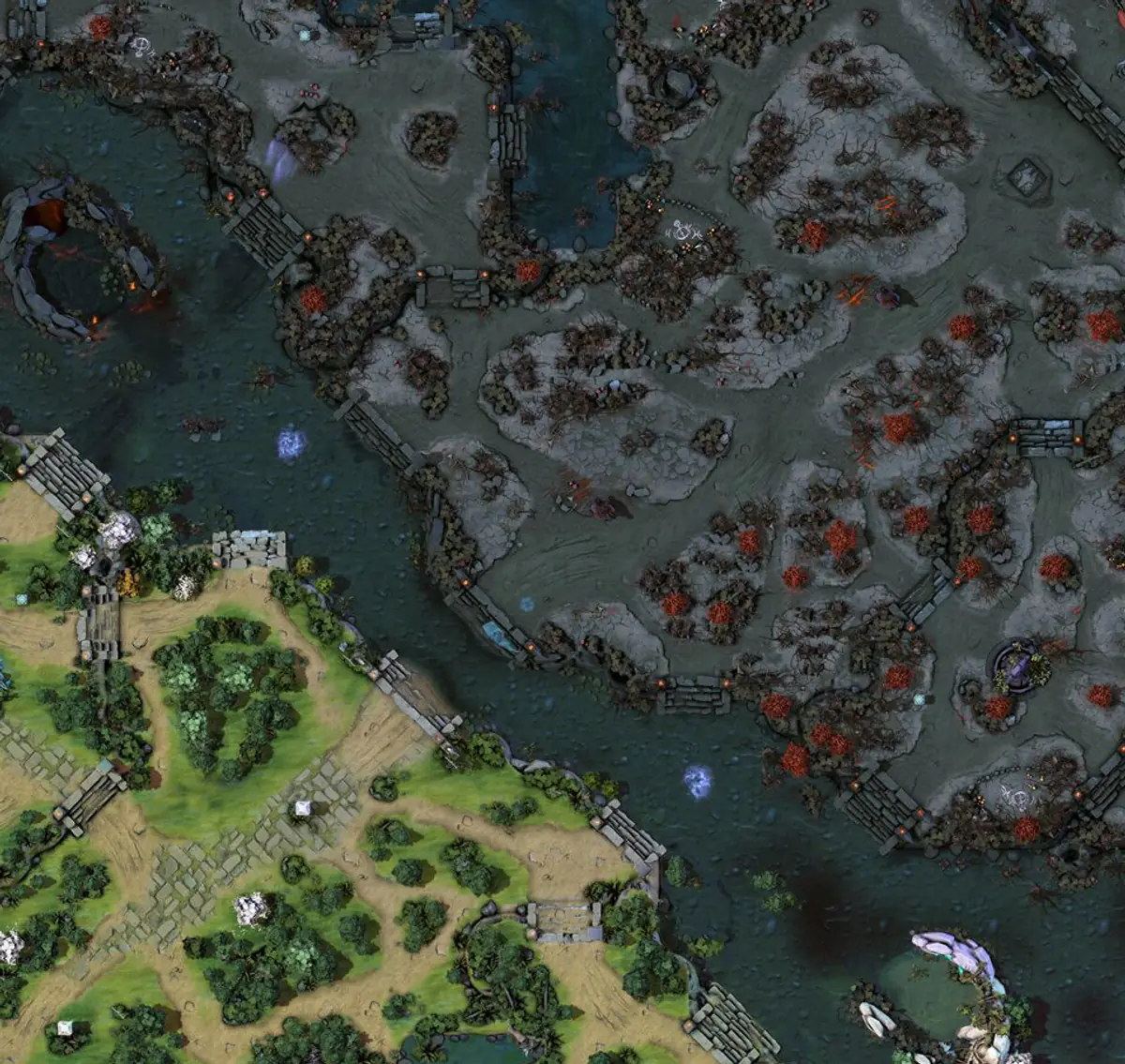
The lanes are named by the side you play, because the map is not symmetrical from a player's point of view. The safe lane is the long lane whose creeps meet close to your tier 1 tower: bottom for Radiant, top for Dire. It is called safe because the tower is near, the two pull camps sit behind it, and an enemy who dives it has to walk a long way home. The offlane is the same long lane seen from the other side: top for Radiant, bottom for Dire. Its creeps meet far from your tower and close to the enemy's, so the offlaner is always the hero playing away from safety. The mid lane is short, symmetrical, and has the two river rune spots at its ends, which makes it the lane where solo play and rune control decide the early game.
Positions 1 to 5
A position is a number from one to five that says how much of the team's gold a hero is supposed to receive. It is a community convention, not a game rule, but it is the convention every team uses when it drafts and when it decides who takes a creep wave.
- Position 1, the carry, farms the safe lane and expects the most gold.
 Anti-Mage is the model: weak early, dominant with items.
- Position 2, the mid, plays the middle lane alone, takes the runes and reaches key levels first.
 Shadow Fiend is the classic example.
- Position 3, the offlaner, holds the hard lane, survives on less gold and starts fights.
 Axe is the model durable offlaner.
- Position 4, the soft support, starts in the offlane, roams early and takes some farm in the middle of the game.
 Tusk is a typical roamer.
- Position 5, the hard support, babysits the carry, buys the
 Observer Ward stock and expects the least gold.
 Crystal Maiden is the model.
Positions 1 to 3 are the cores; 4 and 5 are the supports. The words are a farm-priority scale, so a team can talk about "our 3" or "their 5" without naming a hero, and a hero can move along the scale between games:  Mirana is played at 2, 4 and 5 in 7.41 depending on the team, and the random hero tool and the position hubs use the community's viable-positions list rather than Valve's role tags for exactly that reason. Hero complexity and roles explains how the two systems differ.
Who goes where, and why
The standard assignment is two heroes in the safe lane, one in the middle and two in the offlane. The reasoning is the economy: the carry needs safe farm, so it gets the safest lane and a bodyguard; the mid needs levels, so it gets a lane of its own where every creep's experience is unshared; the offlaner needs to survive against two enemies, so it gets a hero picked for durability and a support to trade with.
This shape is a default, not a law. A team may put its two supports together to protect a carry against a very aggressive offlane pair, send the soft support to the mid lane to help win a rune, or start with a lane swap in which the carry and offlaner change lanes because one matchup is unplayable.  Nature's Prophet can skip the lane map entirely: he teleports to whichever lane or camp needs him, and a few other heroes farm the jungle from the start when the lanes are hostile. The positions guide walks through each position in detail, and the laning phase guide covers the first ten minutes minute by minute.
The one lane where a second hero almost never appears is the middle. A mid hero like  Invoker wants every last hit and every point of experience alone, and a second body would only share it. The mid guide explains why solo experience matters so much there.
What decides a lane matchup
Before the first wave arrives, four things decide who will win a lane:
- Range. A ranged hero harasses a melee hero for free while it walks to a last hit. Melee cores answer with
 Quelling Blade for easier last hits and by staying near their creeps.
- Damage and sustain. Whoever can trade hits and heal back the damage keeps the lane.
 Tango,
 Healing Salve and a cheap
 Iron Branch or two are the standard laning purchases; the mid laner adds a
 Bottle so runes refill it.
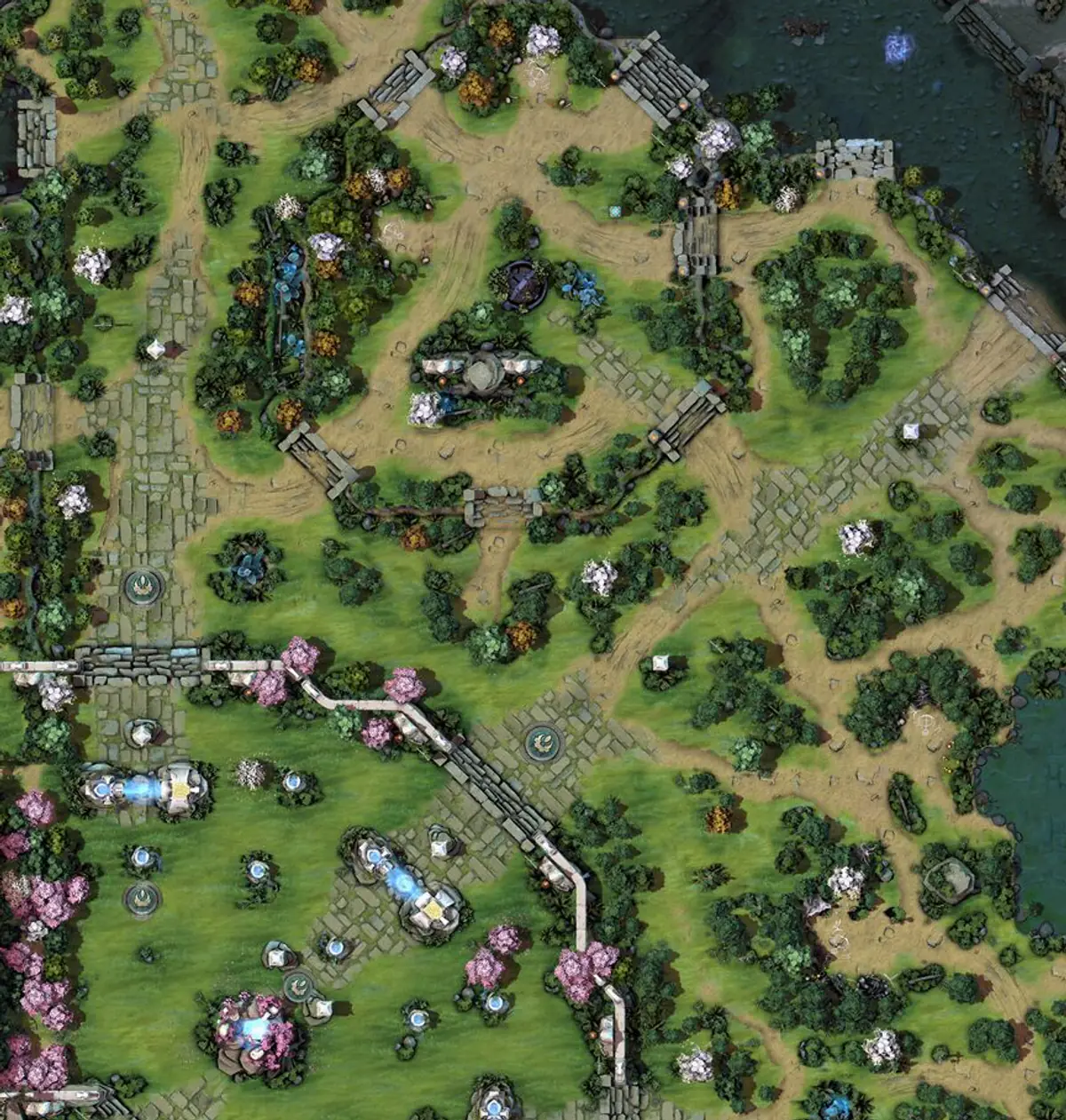
- The pull camps. The safe-lane support can pull a neutral camp into the wave to drag the equilibrium back toward the tower; the offlane pair can block that camp with a ward. Neutral camps, stacking and pulling covers both.
- Kill threat. A pair with a stun and burst can kill a laner who steps forward, and that threat alone forces the other pair to give up last hits. This is where the supports earn their keep, and the carry guide and offlane guide both start with it.
Lane dominance means winning that contest and then using it: zoning the enemy core away from the creeps, denying its experience and forcing its support to sacrifice itself. Denies and their experience rules are on Last hitting and denying; the gold and experience at stake are on Gold and bounties and Experience and levels.
The 7.41 meeting point
Patch 7.41 changed where the side-lane waves meet. Offlane creeps are slowed for a moment as they leave the base and safe-lane creeps are sped up, so the two waves meet closer to the offlane tower than before. The effect lasts until the 7.5 minute mark and then the creeps walk at their normal speed. In practice the offlane pair starts with a slightly better equilibrium and the safe-lane support has to pull earlier to bring the wave back. The exact position is worth checking on the map layer above rather than memorising, because terrain patches move it every few months.
After the laning phase
The two-two-one assignment ends when the first tier 1 towers fall or when a team decides that rotating wins more than farming. From then on lanes are still the map's structure but not a set of posts: the carry moves between the safe lane and the triangle camps, the mid takes whichever lane pushes toward an objective, and the supports rotate to wherever a ward or a fight is needed. Jungle and farming patterns covers where the cores farm once they leave the lane, and the hard support guide and soft support guide cover the rotations.
How it interacts with other mechanics
- Runes. The mid lane is between the two power rune spots, so the position 2 controls them by default; see Runes.
- Vision. The safe-lane support wards the offlane's approach, the offlane support wards the enemy pull camp; see Vision, fog and wards.
- Drafting. The counter picker filters by position because a good matchup in the wrong lane is not a good matchup; the counter picker and random hero tools both carry a position filter.
- The map. Every lane name is defined relative to a side; The map shows where each lane runs for Radiant and for Dire.
Common mistakes
- Treating positions as lanes. Position 4 is a farm priority; the hero can start in the safe lane if the matchup is better.
- Sending two heroes mid. The mid lane's value is unshared experience.
- Holding the standard setup when the matchup is lost. A lane swap costs nothing and can save a carry's first ten minutes.
- Ignoring the 7.41 meeting point. The offlane pair starts closer to its own tower; the safe-lane support should plan the first pull with that in mind.
- Fighting for a lane you have already won. Once the enemy core is zoned, farming and pulling pays more than chasing it.
Heroes this matters for
Anti-Mage — the model position 1 safe-lane carry
Shadow Fiend — the model position 2 mid
Axe — the model position 3 offlaner
Tusk — a roaming position 4

Crystal Maiden — the model position 5 hard support

Mirana — flexible between positions 2, 4 and 5

Invoker — a mid who can play safe lane
Nature's Prophet — a hero who ignores the lane map
Items this matters for
Tango — every laner's first regeneration
Quelling Blade — makes last hits easier for melee cores
Observer Ward — the lane support's first job
Bottle — the mid laner's rune tool
Iron Branch — the cheapest lane stats
Healing Salve — lane sustain
Heroes this affects
Items this affects
Common questions
Which lane is the safe lane?
The lane closest to your own jungle and farthest from the enemy's: bottom for Radiant, top for Dire. Creeps meet nearer your tower there, so the carry can farm with less risk.
What do positions 1 to 5 mean?
Farm priority. Position 1 gets the most gold and plays safe lane, 2 is mid, 3 is the offlane core, 4 is the roaming support and 5 is the hard support who buys the wards.
Do lanes still matter after the laning phase?
Yes. The map is still built from the three lanes and two jungles, and the towers fall lane by lane. Only the strict two-two-one assignment ends; heroes rotate freely after that.
Can a support play in the offlane?
Yes. The position 4 usually starts beside the offlaner and the position 5 beside the carry, but the pair can swap if the matchup is better the other way.
Patch 7.41Checked on Sep 15, 2026