Understanding the Dota 2 Map
The Dota 2 map explained for new players: lanes, jungles, river, rune spots, Roshan pits, Tormentor, Twin Gates and Shrines, and where it is safe to walk.
· Patch 7.41
This page was checked against patch 7.41 and the current patch is 7.41f. The explanation still holds, but any number on it may have moved.
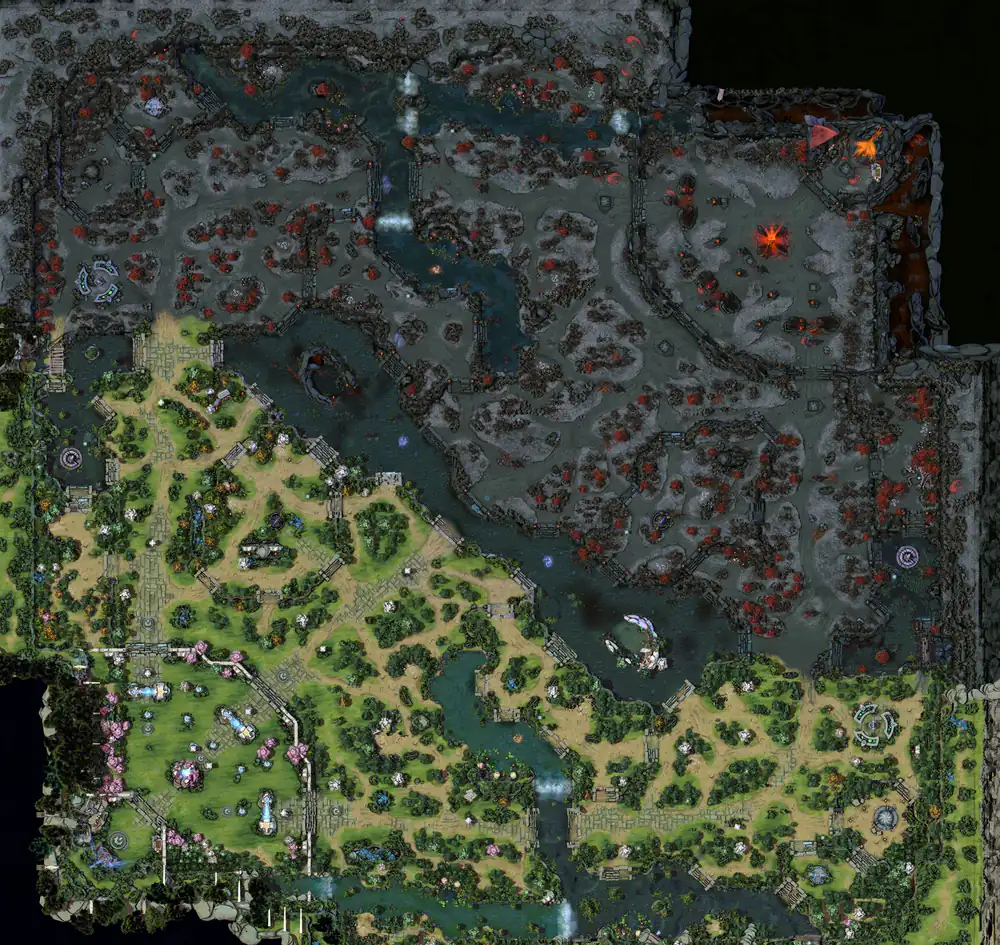
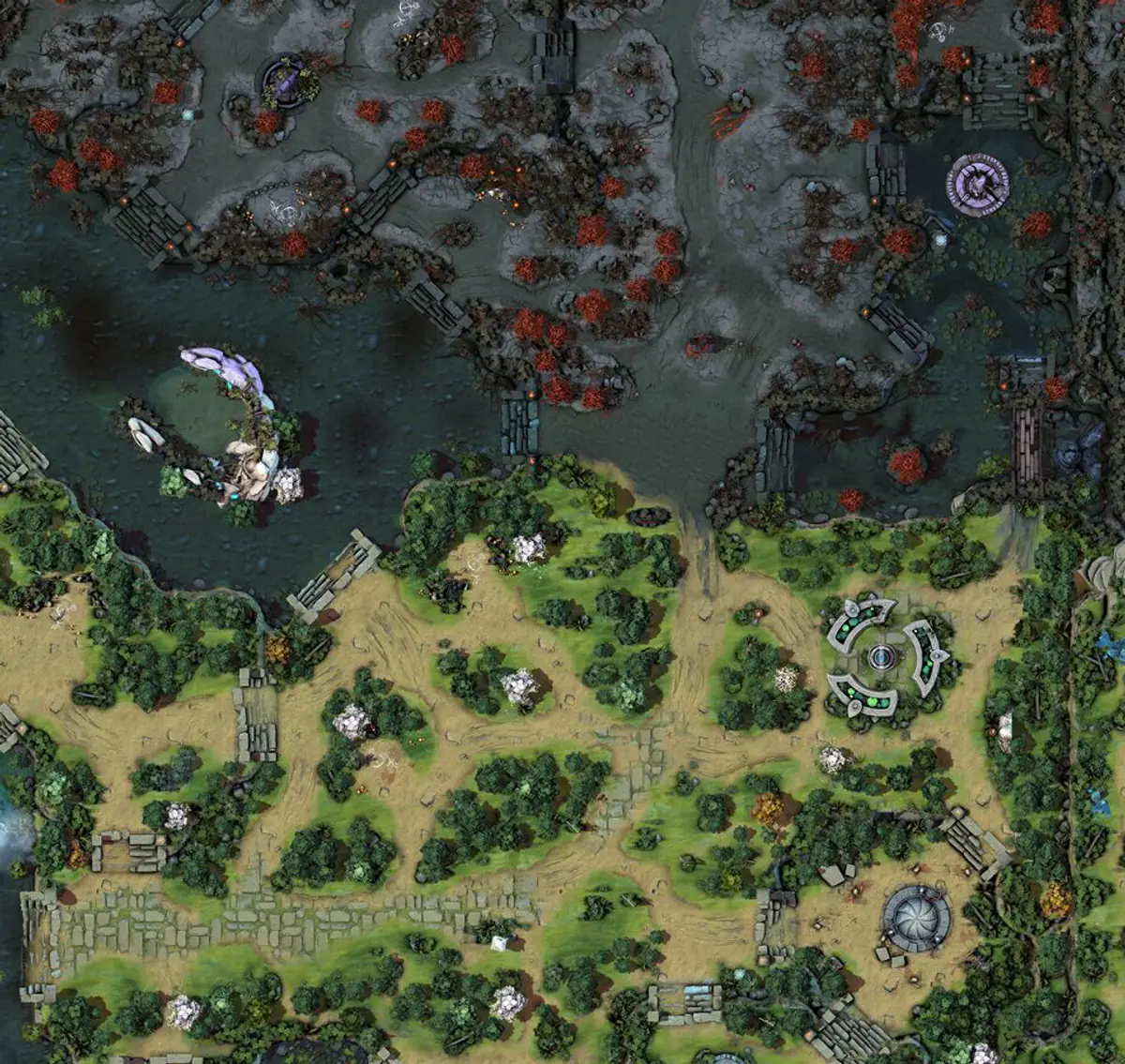
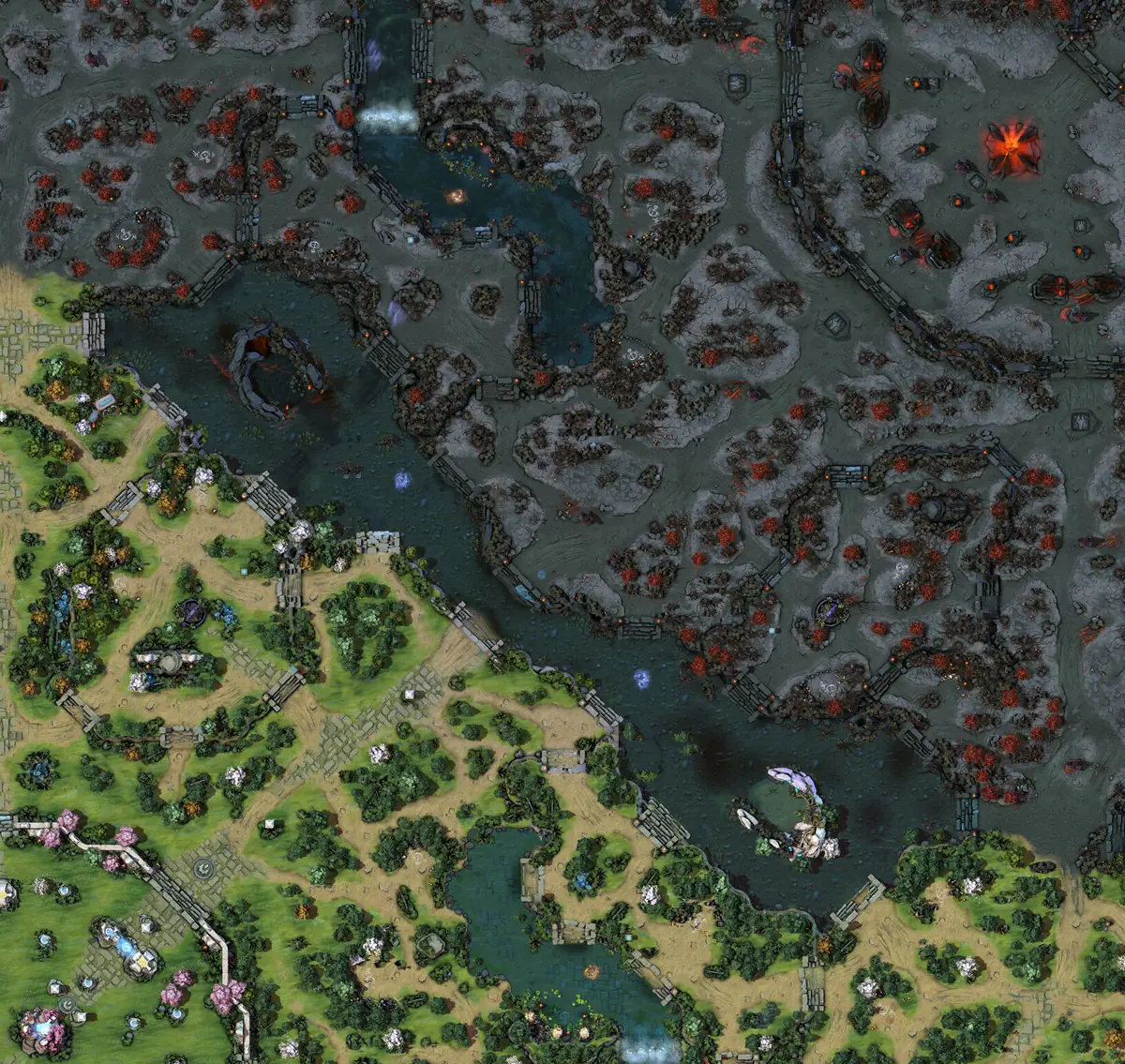
The Dota 2 map is a square with the Radiant base in the bottom-left corner and the Dire base in the top-right. Three lanes connect the bases, a river runs between them on the diagonal, and the four areas between the lanes are the jungles. Everything else is an objective or a shortcut: rune spots in the river and lanes, two Roshan pits, one Tormentor that moves between corners, Twin Gates, Watchers, Shrines of Wisdom, Lotus Pools and Outposts. This guide walks across all of it in the order you will meet it, and says where a new player can walk safely and where not.
- Your safe lane is the one closest to your jungle: bottom for Radiant, top for Dire. The other side's safe lane is your offlane.
- The river is the border. Beyond it, assume every enemy hero is nearby until your team has vision there.
- Neutral camps refill every minute and are the second source of gold after lane creeps.
- Every objective on the map has a timer, and The map lists them all with the numbers rendered from data.
Orientation
Open the map in your mind with Radiant at the bottom-left. The Radiant fountain and Ancient sit in that corner, the Dire fountain and Ancient in the opposite corner, and each base opens onto its three lanes through gaps in a ramp. The base is high ground: attackers from the lane cannot see up the ramp without vision and their attacks can miss, which High ground and uphill miss explains. That is why a losing team can hold its base for a long time.
The map has two names for every lane depending on which side you play. The Radiant safe lane is the bottom lane, and it is the Dire offlane. The Dire safe lane is the top lane, and it is the Radiant offlane. The mid lane is the same for both. When a teammate says "top" or "bot" they mean the lane on the map; when they say "safe" or "off" they mean it from your side. Learn both sets of names in your first matches.
The three lanes
Creeps walk each lane from their barracks to the enemy barracks, and where the waves meet is where the laning phase happens. The safe lane meets near your tier 1 tower; the offlane meets near the enemy's tier 1 tower; the mid lane meets in the middle of the river. Since 7.41 the side-lane waves meet closer to the offlane tower for the first few minutes, so the offlane pair starts with a small advantage. Lanes and positions explains who goes to which lane, and the positions guide explains why.
- 1.Top lane
- 2.Mid lane
- 3.Bottom lane
- 4.Radiant base
- 5.Dire base
Each lane has three towers on each side before the barracks. The tier 1 tower stands roughly a third of the way to the enemy base, the tier 2 tower near your jungle entrance, and the tier 3 tower on the ramp into your base. The Safe lane tier 1 tower is the one you will defend most in your early matches. The Offlane tier 1 tower is the one you will lose first, because the enemy carry farms in front of it.
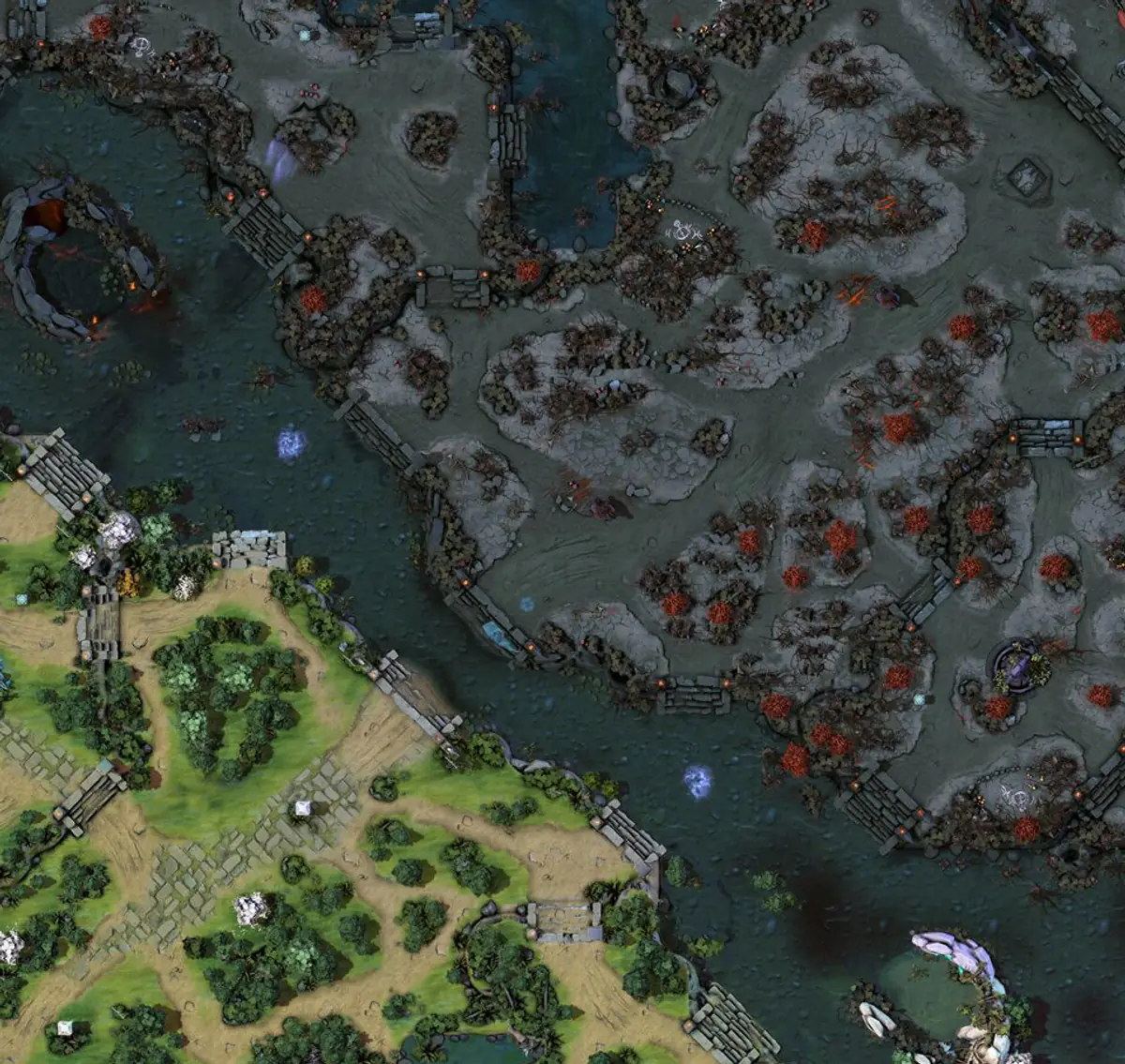
The Mid lane is the shortest and the only one where the two tier 1 towers can see each other's part of the river. The two power rune spots sit at the ends of the river on either side of it, so the mid hero contests the runes and the side lanes stay where they are.
The jungles and the camps
Each side has two jungle areas: a large one behind the safe lane and a smaller one behind the offlane. Both are full of neutral creep camps that spawn at the first minute and refill every minute if the camp is empty. Camps come in four sizes, and each gives a different amount of gold and Madstones. Neutral camps, stacking and pulling covers stacking and pulling; Jungle and farming patterns covers routes through them.
- 1.Hard camp
- 2.Medium camp
- 3.Small camp
- 4.Hard camp
- 5.Medium camp
- 6.Small camp
The camp icons on the minimap tell you the size at a glance.

The corner of the safe-lane jungle nearest the Tormentor is called the Triangle, because three camps sit close together there. It is the carry's farming ground once the laning phase ends, and the enemy team's target when it wants to find that carry. A support who wards the triangle keeps the carry alive; a carry who farms the triangle without a ward is where most mid-game deaths happen.
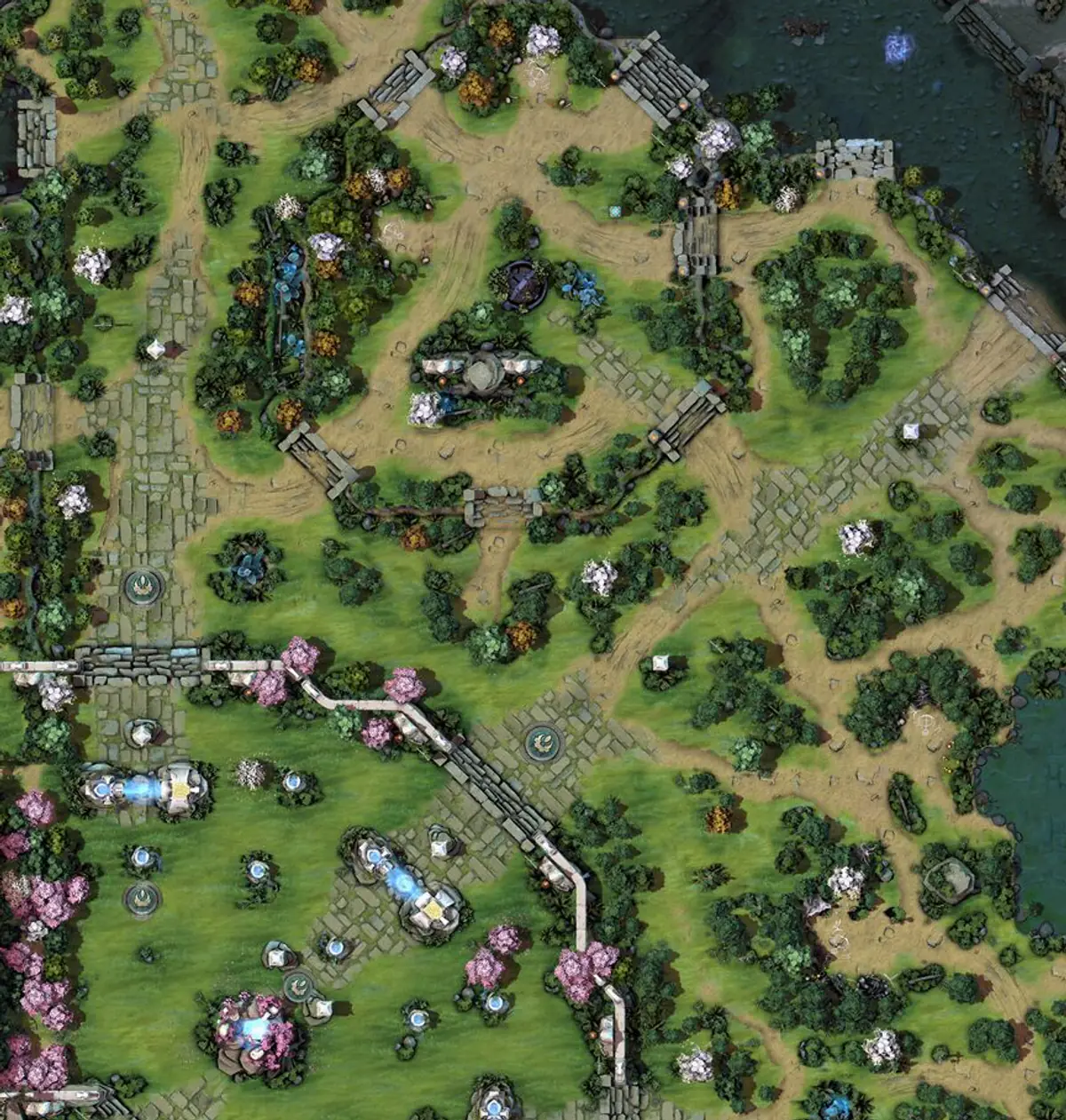
The offlane Jungle is smaller and closer to the enemy carry's farm. Your offlaner and soft support farm it, and it holds one of the Shrines of Wisdom. It is the part of the map where fights over experience happen from the mid game on.
The river, runes and Roshan
The River crosses the map from the top-left to the bottom-right, cutting each lane. It is low ground, so heroes in the river cannot see up onto the banks, and a hero who walks along it is visible from both sides. The two power rune spots sit in the river north and south of the mid lane; bounty runes sit in the jungles; water runes appear at the power rune spots twice in the first minutes. Runes lists each rune, its effect and its spawn timing.
- 1.Power rune spawn
- 2.Power rune spawn
- 3.Bounty rune spawn
- 4.Bounty rune spawn
- 5.Bounty rune spawn
- 6.Bounty rune spawn
- 7.Water rune spawn
- 8.Water rune spawn
Two Roshan pits sit in the river, one near each offlane. Since 7.41 Roshan begins in the top pit. From the 15-minute mark he follows the day and night cycle: the top pit by day and the bottom pit by night. He walks through the river when the phase changes. Only the active pit shows on the minimap. Roshan gives his respawn window and drops, and Day and night cycle explains the clock that moves him. Never walk into either pit alone; the Roshan guide explains when a team takes him.
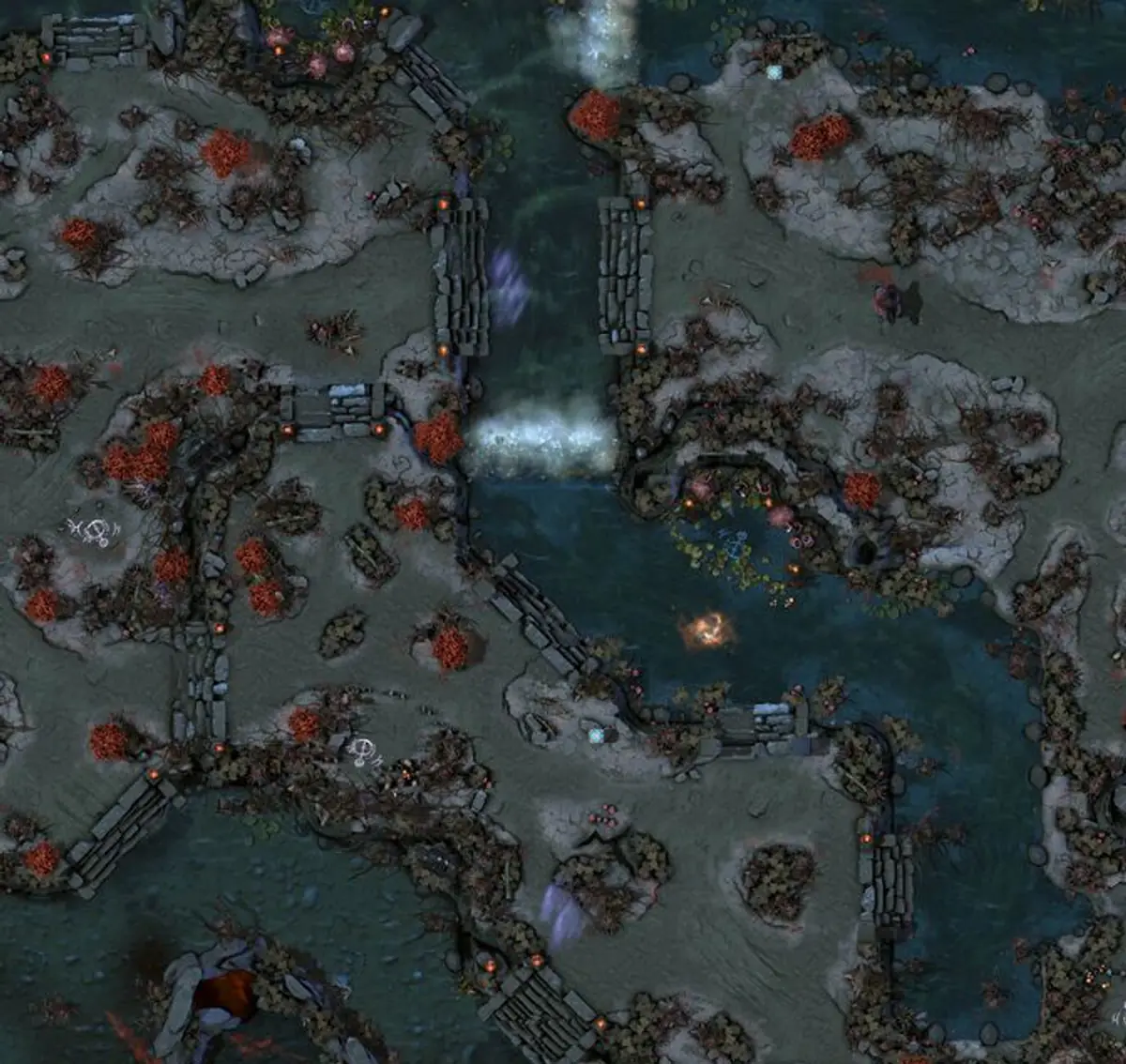
Objectives around the edges
The edges and corners of the map hold the objectives added since 7.33, and most of them work on a timer.
- 1.Roshan pit
- 2.Roshan pit
- 3.Tormentor
- 4.Tormentor
- 5.Watcher
The Tormentor is a single neutral that spawns in a corner at the 20-minute mark. It alternates sides with the day and night cycle, so it is always on the opposite side of the map from Roshan. Killing it grants an Aghanim's Shard to a hero who does not have one. It reflects damage, so it is a team objective, not a solo one. Tormentor covers it.
The Twin Gates are two portals in opposite corners that connect the two safe lanes. Channel next to one and you appear at the other. They are the fastest way from one side of the map to the other and the reason a carry can farm one side while the team fights on the other. The Watchers are pillars in the river and jungles that a hero activates by standing next to them, giving the team vision of the area for a while. Twin Gates and Watchers covers both.
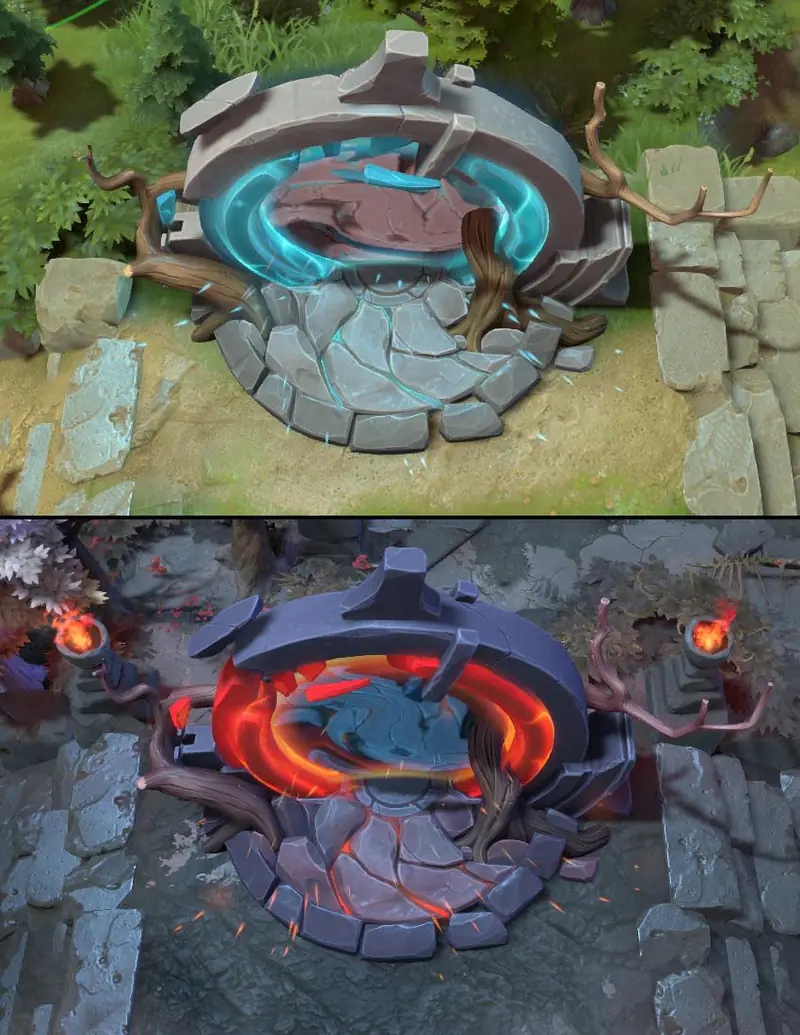
The Shrines of Wisdom stand in the two offlane jungles and grant experience on a timer to whoever channels them; they replaced Wisdom Runes in 7.38. The Lotus Pools sit by the offlane tier 1 towers and grow healing lotuses that any hero can collect. Shrines of Wisdom and Lotus Pools explains both. Two Outposts stand in the triangles as teleport destinations; the buildings page has the current rules under Buildings, and Outpost in the glossary gives the short version.
Buildings and the fountain
Each side has eleven towers, six barracks, an Ancient, a fountain, and the effigies and gates around the base. Towers in a lane must be destroyed in order, and barracks fall only after the tier 3 tower in front of them. Buildings explains the protection rules and what happens to the creeps when barracks fall.
- 1.Radiant Ancient
- 2.Dire Ancient
- 3.Radiant tower
- 4.Dire tower
- 5.Radiant tower
- 6.Dire tower
The tier 2 towers stand at the jungle entrances, and losing one opens your jungle to the enemy. That is the moment a match changes shape: the carry loses its safe farm and the supports lose the ground they warded from. Defend tier 2 towers harder than tier 1 towers, and Teleport to them when they are attacked.
The Fountain heals allies quickly and shoots any enemy that comes near. It is the only place on the map that is always safe, and the only place you can shop for every item; the courier brings the rest. Boots of Travel and the Town Portal Scroll both bring you home. Teleport and buyback explains where a scroll can and cannot take you.
Safe paths and dangerous paths
The map has a rule that keeps beginners alive: stay on your side of the river until your team crosses it together. On your side, walk through your jungle rather than down a lane, because lanes are where enemy heroes look. Beyond the river, walk only where your team has a ward, and read the minimap before every step. Vision, fog and wards explains what you can and cannot see, and the warding guide shows the spots by phase.
The dangerous places, in order: the enemy triangle, the enemy jungle in general, the river at night, and any lane past the enemy tier 1 tower without creeps beside you. Each is a place a hero like  Anti-Mage can leave in a second and a hero like
 Crystal Maiden cannot. The safe places: your fountain, your base, your safe-lane jungle when your carry is not there, and the far corner of your safe lane near the Twin Gate.
 Nature's Prophet ignores the whole list because he teleports anywhere, which is why he is an unusual first hero. A
 Town Portal Scroll makes every place safer, and
 Smoke of Deceit lets a team cross the river unseen for a while. Cores with
 Boots of Travel can go anywhere and return, which is a late-game luxury. The High ground in each base is the last safe place; do not chase enemies up their ramp. The objectives guide explains how a team turns a won fight into towers and map control.
Practice this

- In your next match, pause at the first minute and name the three lanes from your side: safe, mid, off.
- Find the two Roshan pits on the minimap and note which one is active.
- Walk through your safe-lane jungle once and count the camps.
- Place an
 Observer Ward on the river bank near your safe lane and watch how far it sees.
- Open the Roshan and Tormentor timer and follow one spawn cycle while you play.
- Read the HUD guide and find every minimap marker named above on the legend.
- After the match, look at where you died. Most deaths for new players happen beyond the river.
Next reads
- Positions 1 to 5 explained — which lane each position starts in and where it goes after.
- Warding and vision — ward spots by phase and how to deward.
- Farming patterns — routes through the camps on the map you now know.
- The complete beginner's guide — the rest of the first ten hours.
Heroes this affects





Items this affects
Common questions
Which side is Radiant and which is Dire?
Radiant is the bottom-left corner and Dire is the top-right. Radiant's safe lane is the bottom lane; Dire's safe lane is the top lane. The mid lane is shared.
Where is Roshan?
In one of two pits in the river, one near each side's offlane. Since 7.41 he starts in the top pit and, after the early game, moves with the day and night cycle. The active pit shows on the minimap.
What is the triangle?
The corner of each side's jungle behind the safe lane, near the Tormentor corner. It holds several camps close together and is the carry's usual farming ground after the laning phase.
How do Twin Gates work?
Each team has a portal in the corner of its base side, linked to the portal in the opposite corner. Channel next to one and you appear at the other. They connect the two safe lanes and are the fastest way across the map.
Is the map the same for both teams?
Nearly. The two halves mirror each other, but the terrain, tree lines and camp positions differ enough that lanes play differently from each side. Patch 7.41 moved the side-lane meeting point closer to the offlane tower.
Patch 7.41Checked on Sep 15, 2026