Buildings
Every Dota 2 7.41 building: towers tier 1 to 4, barracks, Ancient, fountain, shrines, Outposts and gates, with tower targeting, backdoor protection and Glyph.
· Patch 7.41
This page was checked against patch 7.41 and the current patch is 7.41f. The explanation still holds, but any number on it may have moved.
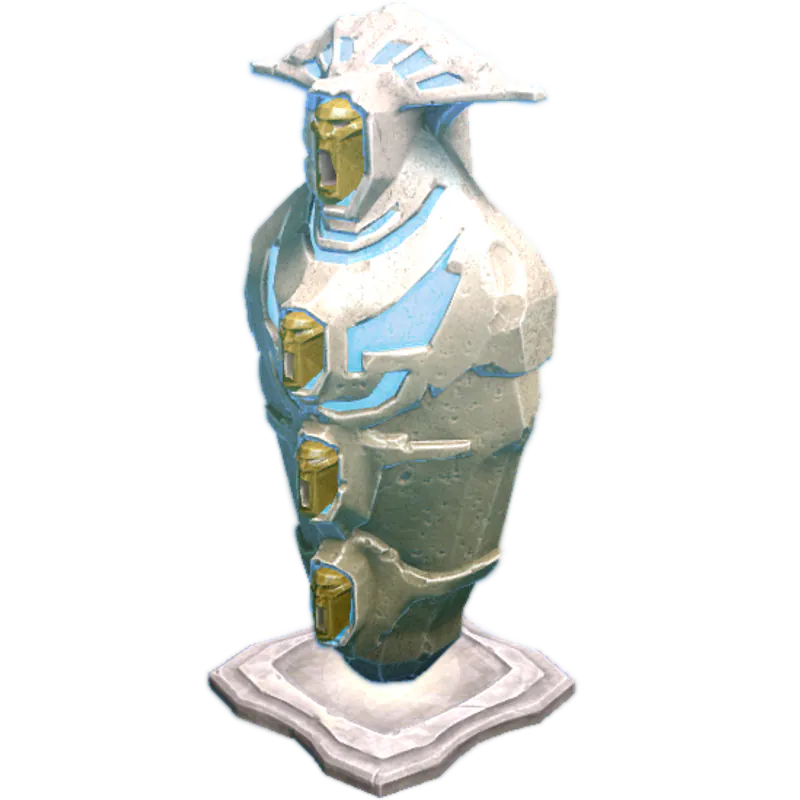

A building is any of the structures that stand still on the map and cannot be moved: the towers in each lane, the barracks and Ancient in each base, the fountains, the Shrines of Wisdom, the Outposts and the Defender's Gates. The towers and barracks are the game's objectives, because the only way to reach the Ancient is through them, and the other buildings are utilities. This page describes each one, the rules that govern how towers target and how buildings are protected, and what each is worth when it falls.
- Each lane has four towers per side; the outer ones must fall before the next becomes vulnerable.
- Barracks decide the strength of your creeps: lose both in a lane and the enemy's creeps there upgrade; lose all six and they become mega creeps.
- The Ancient ends the game and is invulnerable until both tier 4 towers fall.
- Backdoor protection and Glyph of Fortification are the two rules that stop a base from being taken without creeps.
- Tower aggro is a targeting rule you can trigger and reset, and it decides how dives work.
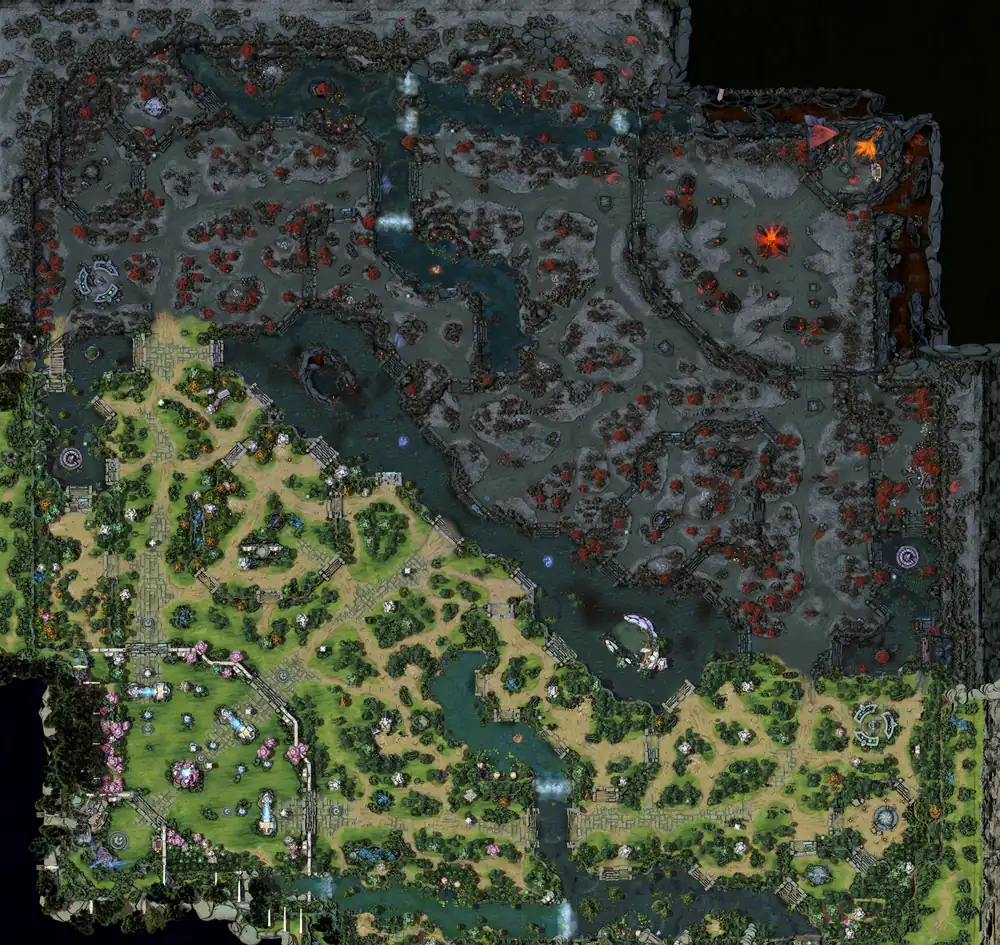
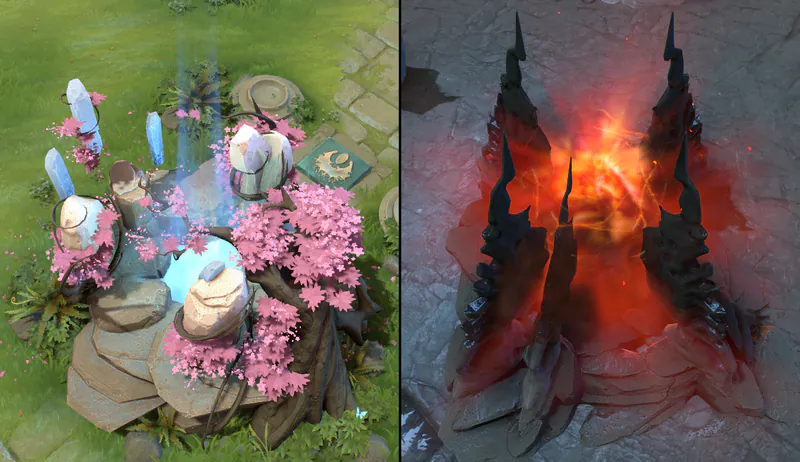
- 1.Radiant Ancient
- 2.Dire Ancient
- 3.Radiant tower
- 4.Dire tower
- 5.Radiant tower
- 6.Dire tower

Towers
Each lane has a tier 1 tower at the far end near the river, a tier 2 in the middle, a tier 3 at the base ramp, and the two tier 4 towers stand together in front of the Ancient. A tower is invulnerable until the tower before it in the lane is destroyed, so a lane is taken in order. Towers hit hard, especially early, deal reduced damage to siege creeps, and can see over trees and onto their own high ground.
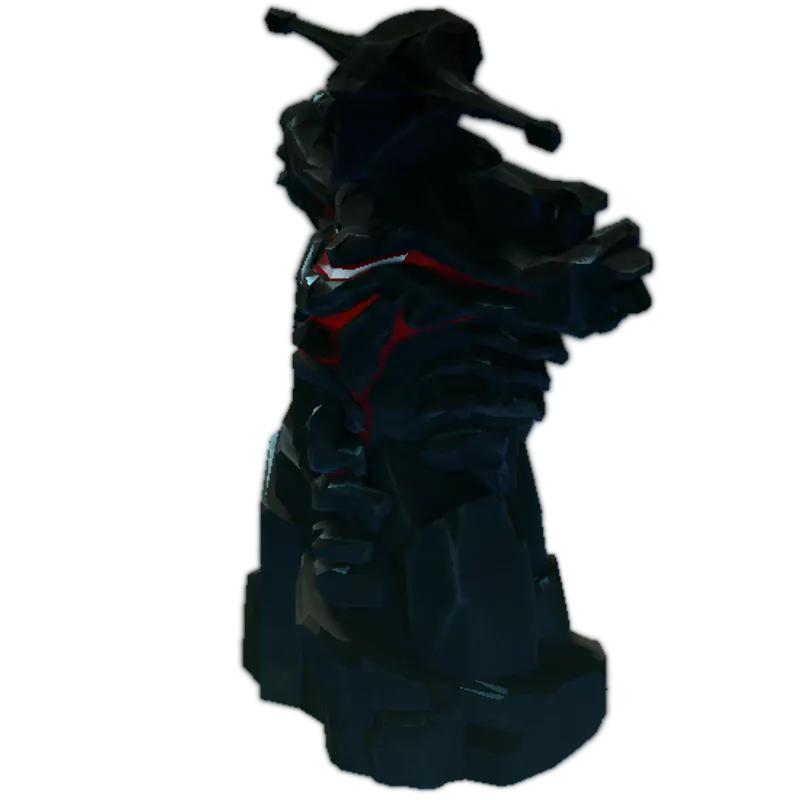

Since 7.40 the tier 4 towers have a Barracks Reinforcement buff: each surviving allied barracks gives both tier 4 towers 4 extra armor, so a base with all six barracks standing has tier 4 towers that are very hard to hit with physical damage, and each set of barracks you destroy makes the last towers softer. Armor and physical damage explains what that armor does to a right-click;  Desolator and
 Assault Cuirass reduce building armor and are the usual answers.
Tower targeting
A tower picks its target by a fixed priority. It prefers the unit that is attacking it, then creeps over heroes, and it keeps a target until that target leaves range or dies. The exception is tower aggro: if a hero attacks an enemy hero within the tower's range, the tower switches to the attacker. That is why a dive under a tower starts with the creeps taking the tower's attention and why a hero who wants to fight under an enemy tower first hits a creep, then the hero, then a creep again to reset the aggro. Attacking a creep or walking out of range makes the tower go back to creeps. Creeps and creep equilibrium has the creep-side version of the rule.
Two details of the priority matter in lane. A tower that is already attacking a creep does not switch to a hero who merely walks into range, so standing under your own tower is safe from the tower's point of view and dangerous only because of the enemy. And a tower holds its target until the target is out of range or dead, so a hero that has pulled tower aggro and keeps attacking will keep taking hits; the reset is a deliberate click on a creep, not a pause.
Barracks and creep upgrades
Each lane has a Melee Barracks and a Ranged Barracks behind the tier 3 tower. Destroying the melee barracks upgrades the enemy's melee creeps in that lane to super creeps, destroying the ranged barracks does the same for the ranged creeps, and destroying all six barracks turns every enemy wave into mega creeps, which are strong enough to end most games on their own. Barracks cannot be denied and do not regenerate on their own. Since 7.36 a team's Glyph refreshes when its first Melee Barracks is destroyed, which gives the losing side one more defense of the next lane.

The Ancient
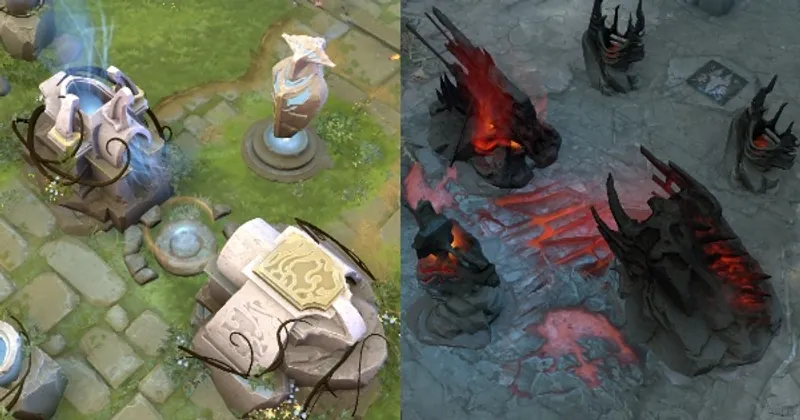
The Ancient is the building that ends the game: the first team to destroy the enemy Ancient wins. It stands in the center of the base behind the two tier 4 towers and is invulnerable until both of them fall. It has heavy armor, regenerates under backdoor protection, and cannot be denied. The nearby Fountain heals allied units and attacks enemies with a powerful, long-range attack that cannot be tanked, which is why fights at the Ancient end at the fountain's edge.

Backdoor protection
Every building past the tier 1 towers has backdoor protection: when no allied lane creeps of the attacker's team are nearby, the building takes a large share less damage, set at 50, and regenerates quickly. The rule exists so that a hero cannot teleport behind the lines and kill a base building alone; a wave has to be there. Player-controlled creeps such as dominated neutrals do not switch protection off, per 7.36. Tier 1 towers have no protection, which is why  Nature's Prophet and
 Lycan can take them with summons while the enemy is elsewhere and why the first towers fall so early.
Glyph of Fortification
Glyph makes every allied building and, for a shorter time, every allied lane creep invulnerable. Its cooldown, durations and refresh rule are on Glyph, Scan and courier; the building-side point is that a Glyph stops a push cold for a few seconds and forces the attackers to either wait under a tower or leave. It refreshes when the team's first Melee Barracks falls.
What buildings are worth
A destroyed tower pays a team bounty to every player on the killing team and a last-hit bonus to the player who lands the killing blow. A tower can be denied by its own team once it is low, which gives the enemy a reduced team bounty and nobody the last-hit bonus; Last hitting and denying covers the timing. Barracks and the tier 4 towers pay in the same shape, and the totals are on Gold and bounties. Beyond gold, a tower is map: the space behind it becomes safe to ward, farm and walk through, which is what the map control guide is about.
The other buildings
- Fountain. Heals and restores mana to allied units, holds the shop and the courier stand, and attacks enemies with an attack that ignores most defenses. It cannot be destroyed.
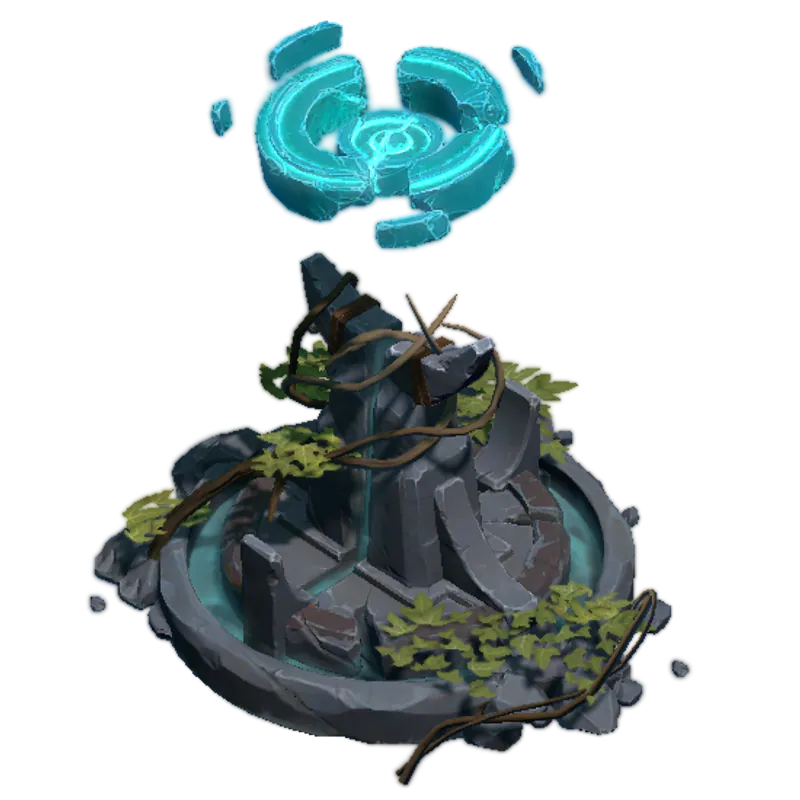
- Shrines of Wisdom. One per side in the offlane jungle, filling with experience on a cycle; explained on Shrines of Wisdom and Lotus Pools. They cannot be attacked.
- Defender's Gates. Added in 7.40 outside each safe lane where the stream enters the base: one-way exits usable only by the team whose base they belong to, with a vision radius of 700 units shown when you hold Alt. They join the 7.33 exit paths near the offlane tier 3 towers.
- Outposts. Two, one in each triangle since 7.34. They no longer grant vision, True Sight or experience (7.33); capturing one takes a channel of 6 seconds and lets your team teleport to it. The corner Outposts added in 7.33 were removed in 7.38.

Taking and holding buildings
Buildings die to creeps plus heroes, not to heroes alone. A push therefore starts with a wave, adds whatever makes the wave bigger, and uses the moment the tower is busy.  Roshan's Banner buffs the creeps that walk past it; Lycan's wolves, Nature's Prophet's treants, a creep from
 Helm of the Overlord and the summons of
 Necronomicon all add bodies;
 Shadow Shaman's Mass Serpent Ward and
 Pugna's Nether Blast deal building damage directly;
 Leshrac's Diabolic Edict melts a tower while the wave holds its attention;
 Lone Druid's Spirit Bear has Demolish; and
 Sniper simply outranges the tower. Defending is the mirror: a
 Town Portal Scroll to the tower, a Glyph timed to the wave, and a hero like
 Tinker who clears creeps from the high ground. High ground and uphill miss explains why the last towers are the hardest, and Teleport and buyback covers the defender's tools. The team fighting guide and the tempo guide cover when to push.
How it interacts with other mechanics
- Vision. Towers give vision on their high ground and along the lane; losing one loses the sight; see Vision, fog and wards.
- Watchers and gates. The Twin Gates and Watchers are map objects, not buildings, and are on Twin Gates and Watchers.
- The map. Every building's position is on The map and the understanding the map guide.
Common mistakes
- Hitting a tower with no creeps. Backdoor protection makes it a waste of time past tier 1.
- Attacking a hero under a tower before the creeps arrive. The tower switches to you.
- Ignoring the barracks. Taking a tier 3 tower and leaving both barracks standing wastes the push.
- Forgetting the Glyph refresh. The first Melee Barracks you destroy gives the enemy a new Glyph.
- Trading a tier 1 tower for a tier 2. The tier 2 pays more and opens more of the map.
Heroes this matters for
Pugna — Nether Blast damages buildings
Shadow Shaman — Mass Serpent Ward destroys towers
Lycan — wolves and Howl push buildings
Nature's Prophet — the classic split-pusher
Lone Druid — Demolish gives Spirit Bear building damage
Leshrac — Diabolic Edict melts towers
Tinker — March of the Machines defends high ground
Sniper — outranges towers
Items this matters for
Roshan's Banner — buffs creeps against buildings
Desolator — armor reduction works on buildings
Assault Cuirass — minus armor aura affects buildings
Town Portal Scroll — defend a building in time
Helm of the Overlord — a dominated creep that pushes
Necronomicon — summons that push buildings
Heroes this affects
Items this affects
Common questions
Why does the tower attack me?
Tower aggro. A tower prefers creeps, but if you attack an enemy hero within its range it switches to you until you stop or leave. Attacking a creep first makes it switch back.
What is backdoor protection?
A rule that makes tier 2 and higher buildings take much less damage and regenerate quickly when no allied creeps are nearby. It stops a hero from killing a base building alone without a wave.
What do I get for killing a tower?
Every player on your team receives a bounty, and the player who lands the last hit receives extra. A denied tower pays the enemy a reduced team bounty.
Do Outposts still exist?
Two stand in the triangles as teleport targets; the corner ones were removed in 7.38. Their vision and experience were removed in 7.33. This page flags the section for an in-client check.
Patch 7.41Checked on Sep 15, 2026